


Although FHIR has been around for several years, its adoption is still not widespread in many regions, especially in Latin America. In conversations with healthcare institutions, a limited view of FHIR is often evident—frequently seen only as a way to comply with national regulatory frameworks. This reactive approach causes organizations to miss out on the true benefits this data architecture can bring, both to their operations and to their patients’ experience.
In this article, we explain what FHIR is, how it works, and why it can be a key enabler of digital transformation in healthcare—beyond regulatory requirements.
What is FHIR?
FHIR (Fast Healthcare Interoperability Resources) is a standard for the exchange of electronic health information developed by HL7 (Health Level Seven International). This modern technology combines elements from earlier standards such as HL7 v2, v3, and CDA, and uses APIs, RESTful services, and formats like JSON or XML to make the exchange of medical data between systems, people, applications, and devices easier.
Its main goal is to simplify interoperability in healthcare without compromising data integrity. FHIR is designed to make patient information easily accessible and understandable to all parties involved in their care—even when the patient moves between institutions.
Además de beneficiar a los pacientes, FHIR también posibilita procesos clínicos automatizados, aplicaciones basadas en inteligencia artificial e integración con equipamiento médico conectado. En este contexto, comprender la importancia de la informática en la medicina permite dimensionar por qué los estándares, los datos estructurados y la integración tecnológica son cada vez más relevantes para mejorar la calidad de la atención.
How does FHIR work?
FHIR organizes medical data into "resources"—discrete units of information such as demographics, allergies, diagnoses, or lab results. These resources are standardized, reusable, and easily shareable across different healthcare systems.
A key feature of FHIR is the use of "profiles", which allow resources to be tailored to specific contexts, such as a region or institution, while maintaining interoperability. For example, a profile might define which fields are mandatory in the “Patient” resource for a national hospital system.
The use of modern web technologies like HTTP, JSON, and XML facilitates integration with mobile apps, cloud systems, and Electronic Health Record (EHR) platforms.
Why is FHIR important?
FHIR addresses one of healthcare’s biggest challenges: interoperability. By enabling the smooth exchange of information between diverse systems, it improves care coordination, reduces duplication of efforts, and contributes to better clinical outcomes. For example, a professional can access the record of a patient treated at another institution, or the patient can share their own data from an app for health monitoring.
Additionally, FHIR fuels innovation: it allows developers to create new health applications that easily integrate with existing clinical systems or complementary platforms. Its flexibility and ease of adoption have made it a go-to standard for hospitals, tech providers, and digital health developers worldwide.
While FHIR is ideal for solving nationwide interoperability challenges—such as implementing unified electronic health records driven by ministries of health— its potential goes far beyond that. This technology can improve internal operational processes, facilitate data analysis, support personalized care, and enhance the patient experience.
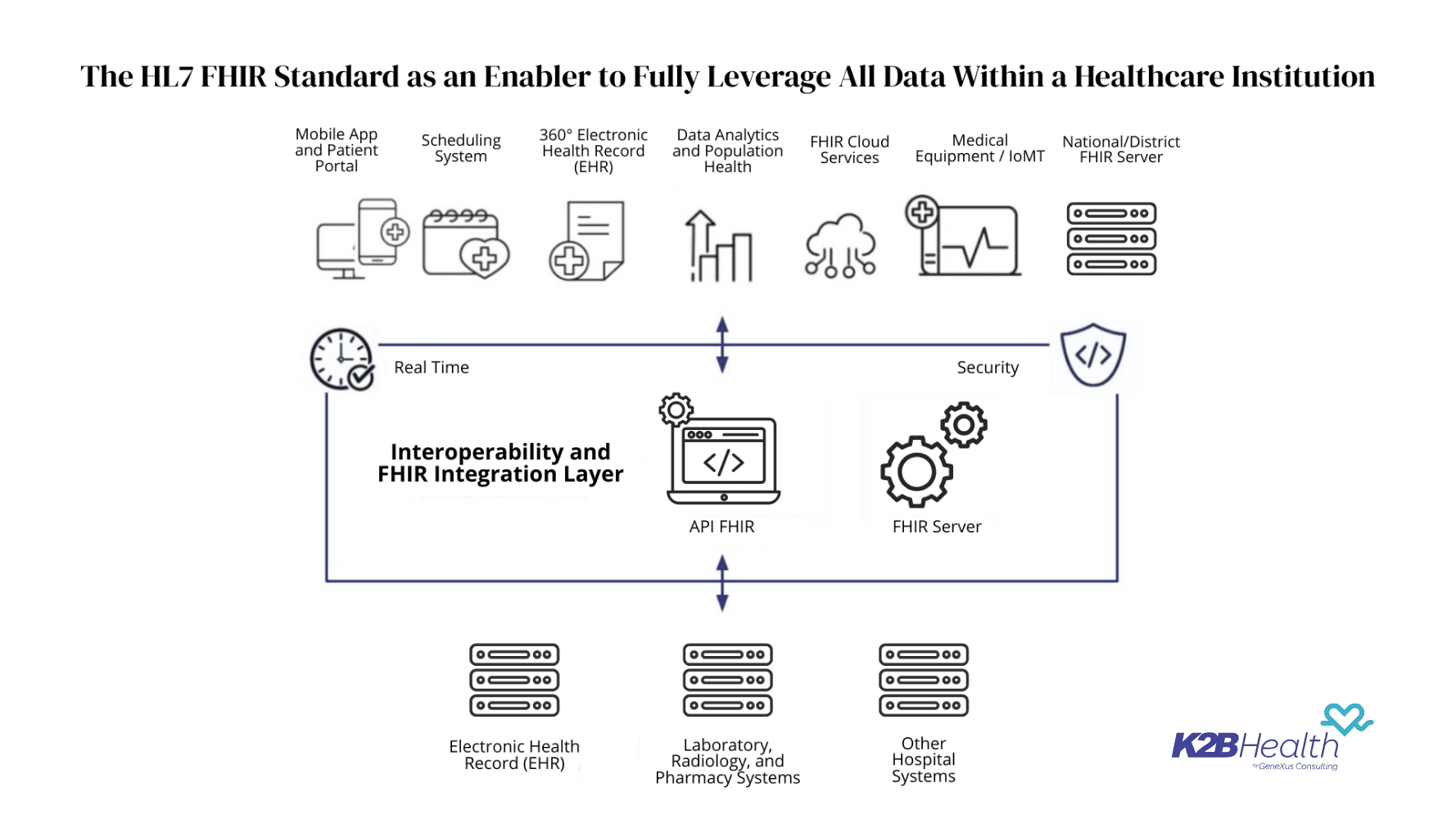
The following diagram shows how FHIR can be applied to various scenarios within a healthcare organization.
What are the benefits of FHIR?
FHIR offers multiple advantages that go beyond just interoperability:
- True interoperability:: Seamless connection between different systems, ensuring an integrated view of data.
- Data exploitation: APIs that enable real-time data sharing and analysis.
- Accessibility: Data available to both patients and professionals from any device.
- Efficiency: Reduced integration effort and cost.
- Innovation: Supports the development of new applications, medical AI, and digital services.
- Scalability: Architecture built on proven web technologies, adaptable to any environment.
Use cases for FHIR
Beyond regulatory compliance, FHIR helps solve multiple clinical and operational challenges:
- Comprehensive health record management: Access and update scattered records across systems.
- Patient-facing health apps: Appointment scheduling, access to personal data, and remote monitoring.
- Data analysis and monitoring: Support for clinical studies, behavior prediction with AI, and service optimization.
- Medical device integration: Real-time communication with wearables and connected equipment.
- Territorial interoperability: Connection between public and private institutions at national or regional levels.
The future of FHIR
As healthcare becomes increasingly digital, FHIR is positioning itself as a key component in the connected ecosystem. It is already being adopted by tech giants like Google, Microsoft, and Apple, and is mandated by regulatory authorities in countries such as the United States.
En este contexto, FHIR permite avanzar hacia un sistema sanitario centrado en el paciente, basado en datos seguros, accesibles y útiles. Su adopción no debe pensarse como una implementación técnica aislada, sino como parte de un proceso de transformación digital en salud orientado a mejorar la continuidad asistencial, la eficiencia operativa y la experiencia del paciente.
So why wait?
The invitation is clear: don’t wait for your country’s regulatory framework to force you to act. FHIR is available today to address real challenges in your institution and to lay the groundwork for more efficient, personalized, and connected care.
Proactively exploring this technology could be the key to improving internal processes, developing new services, and elevating the patient experience to the next level.
En K2BHealth acompañamos a instituciones de salud en la adopción de tecnologías basadas en estándares como FHIR. A través de nuestra Interoperability Platform, facilitamos la integración entre sistemas clínicos internos y externos, centralizando la información y promoviendo un intercambio de datos seguro, eficiente y alineado a los objetivos operativos de cada organización.
Contamos con experiencia en el desarrollo e implementación de soluciones interoperables, diseñadas para responder a los desafíos actuales de la salud digital.
Request a meeting with our team and let’s start working together.