



Digital transformation in healthcare is advancing rapidly, and one of its fundamental pillars is the Hospital Information System, known as HIS.
In this article, we will explore in depth what an HIS is, its main features and functions, and why it has become essential for improving efficiency and quality in medical management. We will also share real experiences from K2BHealth, including the benefits their clients have gained, common challenges in implementing these solutions, and a look into the future of digital health.
What is an HIS?
A Hospital Information System (HIS) is a set of integrated technological solutions that allow for the digital and centralized management of clinical, administrative, and financial processes in a healthcare facility, whether it be a hospital, clinic, or sanatorium.
This system organizes, stores, and processes data related to patients, medical staff, resources, electronic health records, appointments, billing, and more. Its main goal is to optimize the flow of information to improve decision-making, patient care, and operational efficiency.
Why is it so important for healthcare management?
The hospital information system is essential for addressing current challenges in the healthcare system, such as data overload, the need for clinical traceability, reducing medical errors, and improving patient care.
An HIS enables:
- Real-time access to patient information.
- Efficient coordination of all departments.
- Improved planning of human and material resources.
- Compliance with quality and safety standards and regulations.
The adoption of such systems not only optimizes internal operations but also significantly enhances the patient experience.
What functions does an HIS offer?
The main functions of a Hospital Information System cover various areas, including:
- Patient management: admisión, egresos, turnos, camas, derivaciones y coordinación de citas. En este punto, contar con una agenda médica digital permite optimizar la asignación de turnos, reducir ausencias y mejorar la experiencia del paciente. Para profundizar en este tema, recomendamos leer sobre agenda médica digital beneficios.
- Electronic health records: complete and updated records of the patient's health status.
- Electronic prescribing: digital prescriptions with drug interaction alerts.
- Laboratory and imaging: integration with test results.
- Billing and financial management: cost administration, insurance, and collections.
- Statistics and performance indicators: for monitoring and improving internal processes.
- Interoperability: connection with other systems and health organizations.
Advantages of having this system
K2BHealth’s Hospital Information System has established itself as a comprehensive and modular solution that transforms clinical and operational management in healthcare institutions.
Its approach covers all critical aspects of the hospital environment: from admissions, bed management, and outpatient care to emergencies, hospitalizations, surgeries, and oncology treatments.
This HIS includes modules such as Sanatorium Management, Electronic Health Records (EHR) for different areas (outpatient, emergency, inpatient, surgical block, oncology), Coordination and Scheduling, and a Patient Portal. All these components are designed to integrate with each other or function independently, adapting to the specific needs of each institution.
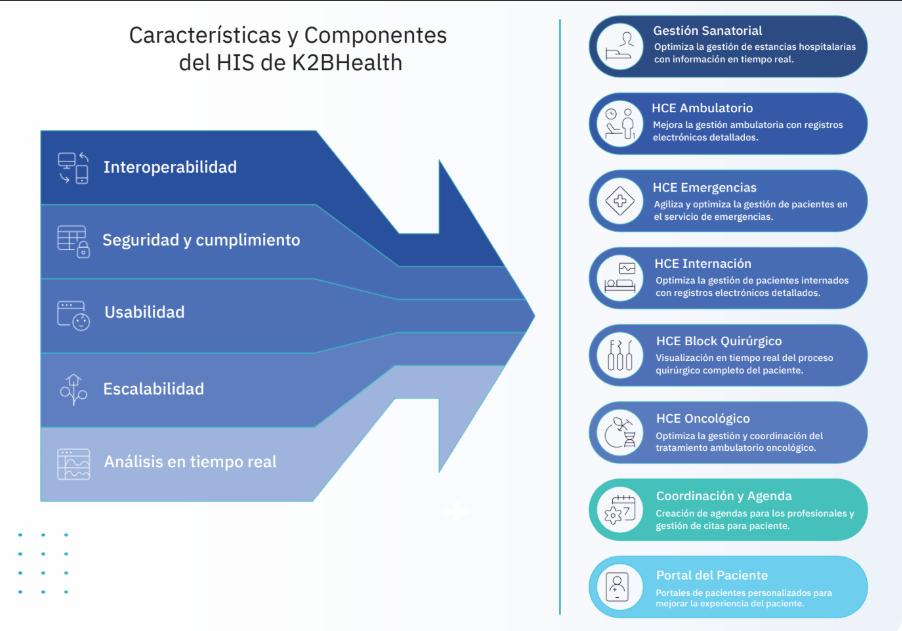
Its main features include:
- Interoperability: permite integrarse con otros sistemas del entorno tecnológico del cliente (laboratorios, farmacias, dispositivos médicos), cumpliendo con estándares como HL7 V2.5, HL7 CDA y HL7 FHIR, lo que facilita el intercambio seguro y eficiente de datos clínicos y ayuda a las instituciones de salud a prepararse para nuevos marcos regulatorios, como la resolución 1888 de interoperabilidad clínica.
- Usability and user experience: its intuitive interface encourages adoption by medical and administrative staff, reducing errors and speeding up care.
- Usabilidad y experiencia de usuario: su interfaz intuitiva favorece la adopción por parte del personal médico y administrativo, reduciendo errores y agilizando la atención.
- Scalability and flexibility: designed to support institutional growth, whether due to increased patient volume, new departments, or integration of technologies like artificial intelligence.
Thanks to this robust and adaptable solution, K2BHealth clients have achieved substantial improvements in operational efficiency, team coordination, quality of medical care, and continuous patient monitoring.
Challenges in the healthcare system
Despite its benefits, implementing a hospital information system also presents challenges, such as:
- Resistance to change from staff.
- Lack of technological infrastructure in some institutions.
- Need for ongoing training for teams.
- Interoperability with legacy or non-standardized systems.
At K2BHealth, we work to support teams through this change process by offering technical support, training, and solutions tailored to each context.
What does the future hold with healthcare digitalization and the impact of artificial intelligence on HIS?
The digitalization of the healthcare system is progressing steadily, and in this process, Hospital Information Systems (HIS) play a central role as integrators of clinical, operational, and administrative data. However, the transformation doesn’t stop at digitalization: artificial intelligence (AI) is emerging as a disruptive element that will radically change how HIS function.
How will AI transform HIS?
- Clinical diagnosis support:
With predictive analytics, AI-enabled HIS can process large volumes of clinical data in real time to detect patterns, predict diseases, and support medical decisions. For example, systems trained with thousands of images can alert to anomalies in imaging studies before the human eye can detect them. - Automation of administrative tasks:
Functions such as clinical coding, data entry, schedule management, or record auditing can be automated with AI, freeing staff from repetitive tasks and improving operational efficiency. - Personalized data-driven care:
HIS integrated with AI can analyze a patient’s complete history and suggest personalized treatments, detect early clinical risks, or propose preventive interventions. This is key for value-based care and population health models. - Improved resource management:
Using AI algorithms, HIS can forecast demand for beds, staff, or medications, optimizing hospital planning and the allocation of critical resources. - Clinical Decision Support Systems (CDSS):
AI-powered CDSS integrated into HIS help physicians make evidence-based decisions, provide alerts for drug interactions, or offer contextual clinical recommendations. - Smart interoperability:
AI can also facilitate the normalization and semantic mapping of data from different systems and standards (HL7, FHIR), promoting true clinical interoperability. - Easy access to information through natural language:
The integration of conversational assistants allows healthcare professionals to query the system using natural language, quickly and easily accessing the clinical information they need without complex searches or navigating multiple screens.
The digitalization of the healthcare system is not just a step toward electronic processes: it is the gateway to a more preventive, personalized, efficient, and patient-centered model. And in this future, artificial intelligence will be an essential component of HIS.
If you’re interested in learning more about how technology is transforming the sector, we invite you to read our article on digital transformation in healthcare..