



The clinical history is an essential document in healthcare and goes by different names depending on the country: clinical record (México), medical record (Chile), or medical history (Spain), among others. Despite the variations in name, its function is universal: to collect and organize vital medical information.
This article will explore in depth what an electronic health record is, how it is structured, the impact of its digitalization, the advantages and disadvantages of this process, and the future of medicine with the digitalization of these records.
What is the medical record and why is it so important?
The clinical history It is a comprehensive record of a patient’s health data, documenting everything from initial symptoms to treatments and outcomes. It serves as the foundation for medical care, allowing healthcare professionals to make informed decisions, provide accurate diagnoses, and monitor the patient's progress. It is essential for ensuring personalized, evidence-based care and also plays a crucial role in public health research and statistics.
How is it structured? Example of a medical record
The structure of a medical record follows a defined framework that allows for the organized collection of patient information. It typically includes the following sections:
- Personal information: Name, age, sex, address, contact information.
- Reason for consultation: The main reason why the patient visits the doctor.
- Background: Family and personal medical history, allergies, previous illnesses.
- Physical examination: Results of the physical evaluation of the patient.
- Diagnosis: Diagnostic impression based on the information collected.
- Treatment: Drugs and procedures indicated.
- Evolution: Record of the patient's progress.
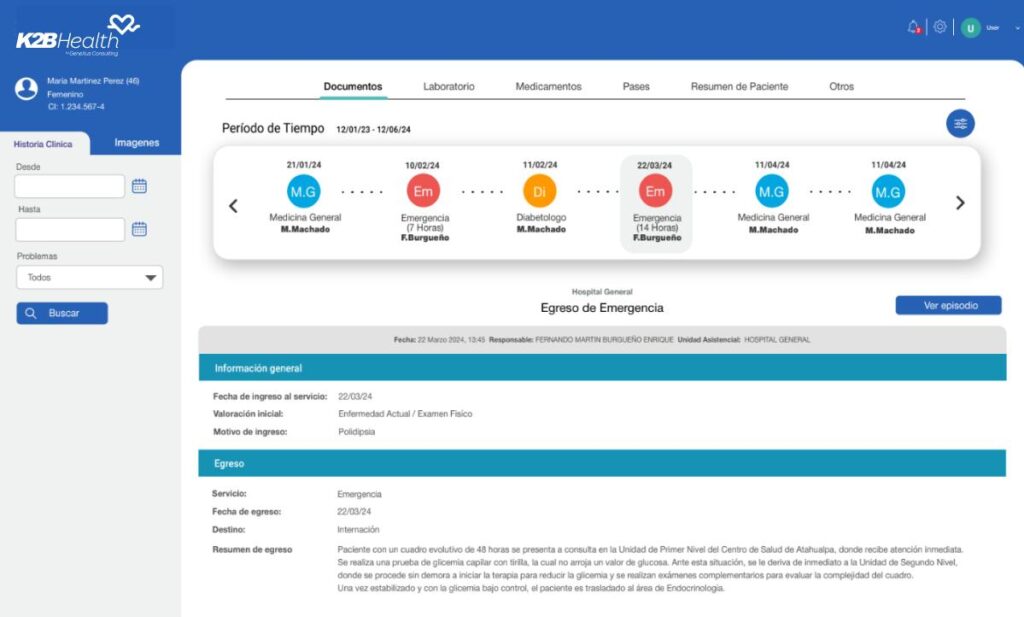
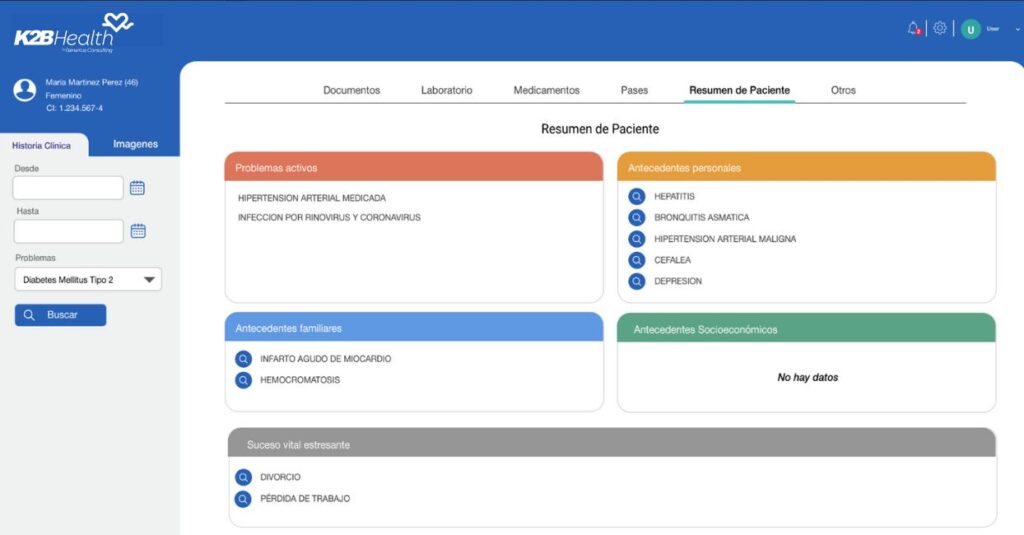
K2BHealth Electronic Health Record Example
Access to documents:
Patient summary:
Digital medical records, what is that?
As healthcare moves towards modernization, the digitalization of the medical record has become a key element.
The digital medical record (DMR) represents a fundamental transformation in the management of medical information. It is the electronic version of the paper record but also offers a comprehensive platform to manage and organize all of a patient's health data.
The DMR not only stores clinical information in digital format but also allows for quick and secure access by authorized healthcare professionals. This facilitates the instant availability of data and centralizes a patient’s medical history, allowing it to be used in multiple care settings. Thus, digitalization promotes a more efficient flow of clinical information, which is essential for informed decision-making in patient treatment and follow-up. In this way, the DMR complements the traditional structure of the medical record, improving continuity of care and enhancing the quality of medical services.
Advantages and disadvantages of digitalizing the medical record
Advantages:
- Accessibility: Patient data is available anytime and anywhere.
- Interoperability: Facilitates the exchange of information between different healthcare institutions, improving continuity of care.
- Reduction of errors: Minimizes the risk of transcription errors and improves data accuracy, contributing to safer and more effective care.
- Security: Electronic Health Records (EHRs) typically have encryption systems and controlled access to protect patient privacy.
- Better decision-making: Access to historical records and previous treatments facilitates more accurate diagnoses. ```
- Time and space savings: There is no longer a need to physically archive records, reducing costs and space.
- Operational efficiency: Reduces the time spent searching for information and streamlines workflows among medical teams.
- Data analysis: Facilitates the collection and analysis of large volumes of information to improve medical research and health statistics.
- Sustainability: By eliminating paper, it helps reduce the environmental impact of the healthcare sector.
Disadvantages:
- Implementation costs: It requires a significant investment in technology and staff training, but the long-term benefits, such as greater efficiency, savings in resources, and improvements in the quality of care, make this investment worthwhile.
- Risk of cyberattacks: There is a possibility of data breaches, but implementing robust cybersecurity measures and ongoing training can significantly reduce these risks and protect sensitive patient information.
- Technological dependency: If there are system failures, access to records may be interrupted.
What will the future of medicine look like with the digitization of the clinical record?
The digitalization of clinical records marks a turning point in medical care. In the future, it is expected that the electronic health record will not only be a repository of information but also a predictive tool, thanks to the integration of artificial intelligence (AI) and big data. This will allow for the identification of disease patterns, anticipation of complications, and further personalization of treatments. Additionally, telemedicine and interoperability between health systems will enhance continuity of care, even on an international level.
K2BHealth, como socio tecnológico clave, ha sido fundamental para posicionar a Uruguay como un referente en salud digital a nivel regional. Hemos participado en la generación de soluciones para la Historia Clínica Digital en Uruguay, la Historia Clínica Oncológica, y un sinfín de soluciones para distintos prestadores de salud que le permiten a K2BHealth ofrecer un profundo conocimiento de la industria, de los estándares internacionales aplicables y de las últimas tendencias tecnológicas en salud.
Frequently Asked Questions
- What does a medical record include?A medical record includes personal data, medical history, diagnoses, treatments, and patient progress.
- What is the difference between a paper medical record and a digital one?The paper medical record is physical and susceptible to loss or damage, while the digital one is accessible from anywhere, more secure, and facilitates medical coordination.
- What are the advantages of the digital medical record?Greater accessibility, security, time savings, improved decision-making, and long-term analytical capabilities.
- How does the digital medical record affect patient privacy?While digitization carries risks, secure platforms implement strict data protection measures, such as encryption and access control.
- Is the digital medical record compatible across different health systems?It depends on the degree of interoperability of the systems, but more and more institutions are adopting common standards to ensure compatibility.
- How is my digital medical record updated? Authorized health personnel can update it in real-time after consultations, procedures, or treatments, ensuring that it is always up to date.
Conclusion
The medical record, both in its traditional and digital forms, has been a fundamental pillar in healthcare, allowing for detailed tracking of each patient's progress. With digitalization, this record has significantly improved, optimizing response times, enhancing coordination among teams, and ensuring greater security and accessibility in data management.
Moreover, the integration of technologies such as artificial intelligence and data analytics is driving the evolution toward a more predictive, proactive, and personalized medicine. This transformation will allow for anticipating health problems and adjusting treatments with greater precision, which will not only improve clinical outcomes but also contribute to more efficient patient-centered care.
Looking ahead, the digital medical record is poised to become an indispensable tool for research, healthcare management, and continuous improvement in the quality of medical services. This vision points toward a more connected and efficient healthcare system, where patient well-being is at the center of every decision.
En este escenario, contar con un Electronic Health Record Software permite consolidar la información clínica en una plataforma segura, accesible y preparada para acompañar la evolución de las instituciones de salud.